Sponsored by: a medical device company
Project Summary
Implantable pacemakers, neurostimulators, diagnostic devices, and drug pumps are used to manage a variety of diseases including atrial fibrillation, Parkinson’s, incontinence, and pain. Many of these systems require a remote control for use by the patient. Previous remotes can be too complex in many cases. Our team designed and prototyped a new remote control that prioritizes simplicity, usability, and aesthetics. The new remote is compact, user-friendly, and accessible to a wide range of patients, ensuring they can easily adjust their therapy as needed. This improved design enhances the overall patient experience while maintaining the technical precision required for effective treatment.
Design Goal
Design a simple remote for patients to manage therapy. This device should seamlessly integrate with existing systems while being optimized for users with limited dexterity, easy to use intuitive experience.
Design Constraints
- The team shall design and develop a mini-remote that features no more than two buttons.
- The prototype shall communicate with a phantom implantable device.
- The prototype interface shall support turning a phantom implant On to Off and Off to On.
- The design shall require little or no training for someone with cognitive, visual, or hearing impairment.
Download the project summary (PDF file).
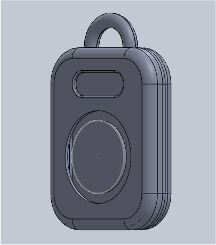
SolidWorks image of Mini Remote design.
Members of the Project Team
Student Team:
- Lucas Linnemann - Major: Computer Engineering
- Henry Fischer - Major: Electrical & Mechanical Engineering
- Kai Anderson-Lantz - Major: Computer Engineering
- Olivia Matuska - Major: Mechanical Engineering
Industry Representatives: Andrew Fried & Jacob Komarek
Faculty Advisor: Michael O'Connor

Pictured left to right: Lucas Linnemann, Henry Fischer, Kai Anderson-Lantz, Olivia Matuska.